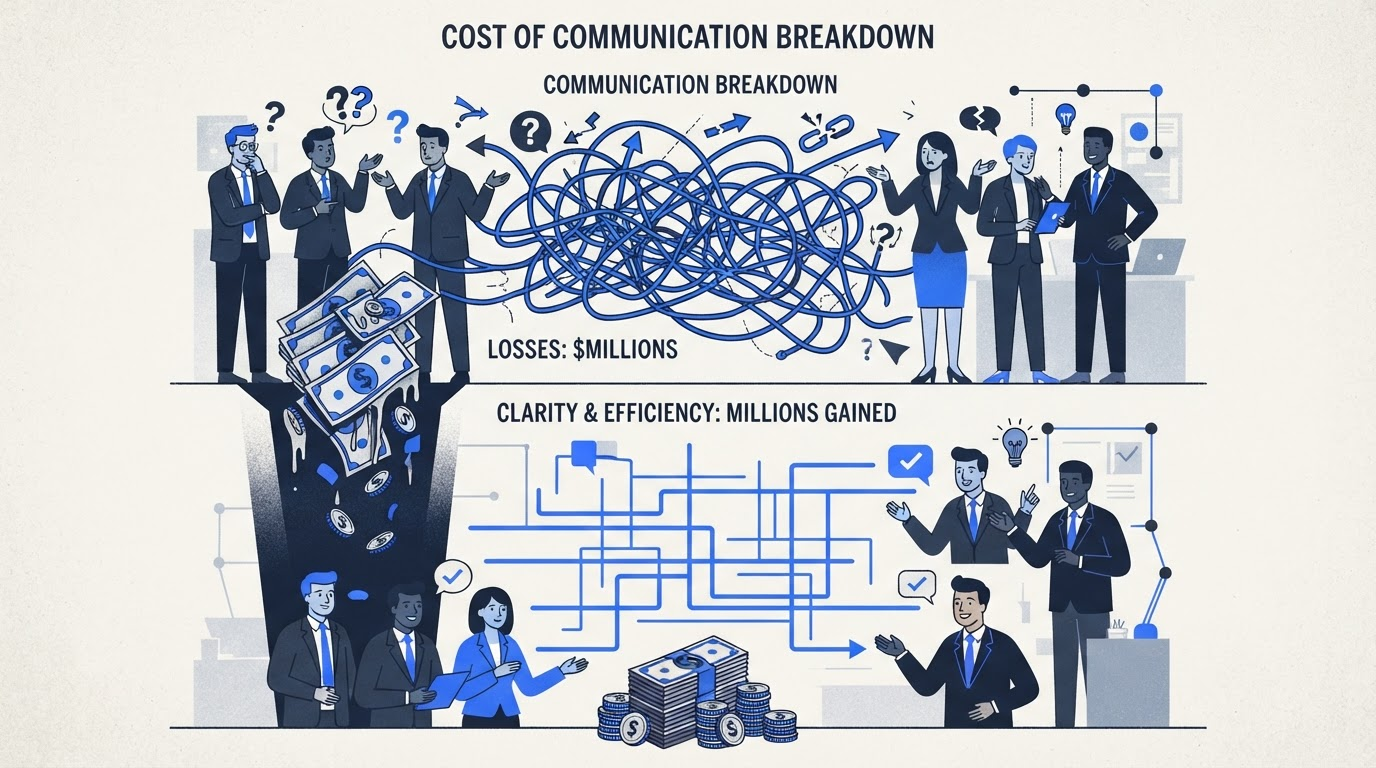
Team Communication Breakdown: 3 Costly Types Hitting Your P&L – And the Fix Leaders Need
Picture this: a project manager dashes off a quick Slack message about a deadline shift, but the team reads it as business as usual. Two days later, deliverables crash into overtime chaos, burning through $15,000 in rushed contractor fees. That's not fiction—it's the hidden math of team communication breakdown, and it lands square on your profit and loss statement every time.
As an executive or team lead, you've felt it: the frustration of goals fizzling out, morale dipping, and revenue slipping through cracks you can't even see. Poor communication isn't just awkward—it's a communication costing business nightmare. Let's break down the numbers. For a mid-sized team of 20, assume one major misfire weekly: 4 hours wasted per person at an average loaded hourly rate of $75. That's $6,000 evaporated per incident, or over $300,000 annually. Multiply by turnover from frustration (20-30% higher in siloed teams), and you're staring at seven figures. Every garbled memo, skipped check-in, or assumed alignment chips away at your bottom line.
But here's the leadership truth: these breakdowns aren't random. They cluster into three deadly patterns, each with a direct line to your P&L. Spot them, and you reclaim control. Master effective team communication, and you turbocharge execution.
Breakdown #1: Unclear Expectations – The Silent Revenue Killer
Expectations float like fog in too many teams. A VP outlines a "priority push" on quarterly targets, but without specifics—who owns what, by when, success metrics undefined—the sales crew scatters. One executive scenario: the marketing head greenlights a campaign tweak, assuming the ops team grasps the budget cap. They don't. Spend balloons 40% over, torching margins on a key product launch.
This team communication breakdown breeds rework and missed opportunities. Deadlines slip, clients churn, and your P&L bleeds from inefficiency. Quantify it: unclear tasks double completion time, per standard productivity models, turning a $50K project into a $100K drag.
Breakdown #2: No Feedback Loop – The Progress Black Hole
Feedback isn't optional; it's oxygen for alignment. Without it, efforts veer off-course unnoticed. Imagine a product lead assigns feature development, then ghosts the dev team amid back-to-back meetings. Weeks in, the build veers wildly from specs—only revealed at demo day. Scrap it all, delay launch by a month, lose $200K in projected sales.
This gap in leadership communication fosters isolation. Teams grind in vacuums, piling up defects and distrust. The P&L hit? Escalating error rates (up 25% without loops) mean higher support costs and eroded customer trust, compounding into lost repeat business.
Breakdown #3: Assumption-Driven Execution – The Trust Time Bomb
We all assume shared context—until it explodes. A COO nods at a vendor pivot, presuming finance has vetted costs. They haven't. Contracts sign, overruns hit, and suddenly Q3 forecasts crater by 15%. Another real-world flashpoint: remote teams "sync" via email threads, each filling blanks with their lens. Execution fragments, innovation stalls, and competitive edge dulls.
Assumptions erode velocity. They spawn conflicts, inflating HR interventions and attrition—direct assaults on your communication costing business reality. A single cycle can shave 10-20% off throughput.
Unmask the Damage: Your Hidden Cost Formula
Time to get precise. Use this dead-simple formula to audit your exposure:
Annual Communication Cost = (Team Size) × (Miscommunications/Week) × (Hours Wasted/Miscomm) × (Avg Hourly Rate) × 52
Plug in your numbers. Team of 15, two breakdowns weekly, 3 hours lost each at $80/hour? $118,800 yearly—before ripple effects like turnover (add 1.5x salary per departure) or opportunity costs. This isn't theory; it's the ledger staring back at you. Track it quarterly, and watch team communication breakdown shrink.
The Antidote: Build Your Communication Operating System
Leaders don't wish for clarity—they engineer it. Enter the Communication Operating System: a lean framework reclaiming your P&L through disciplined effective team communication. Deploy these three pillars relentlessly.
Pillar 1: Weekly Clarity Huddles
Ditch endless emails. Gather 15 minutes weekly: restate top three priorities, assign owners with deadlines, flag risks. One exec transformed a flagging ops team—huddles surfaced blockers early, slashing delays by 35% and boosting output.
Pillar 2: Written Scorecards
Visualize success. Co-create one-page scorecards per initiative: goals, metrics, milestones. Share post-huddle, review next week. This crushes unclear expectations, turning vague nods into accountable action. Teams hit 90%+ on-time delivery when scorecards rule.
Pillar 3: Closed-Loop Confirmation
End every handoff with echo-back: "Confirm you heard: deliver X by Y, measured by Z." Assumptions die here. A sales director enforced it post-chaos; pipeline velocity jumped 28%, deals closed faster.
- Roll out in 30 days: Train, template, track.
- Measure wins: P&L lift via reduced waste.
- Scale company-wide for exponential gains.
This system isn't fluffy—it's your competitive moat. Executives wielding it report 20-40% productivity surges, directly padding profits.
Reclaim Your Edge – Starting Today
Team communication breakdown ends when leaders demand better. You've seen the costs; now seize the fix. Jim Marsh of JEM Premier Coaching has guided hundreds through this transformation—don't let another quarter slip.
Grab your free Communication Operating System guide at jemexcellence.com/guide. Customize the formula, templates, and rollout playbook instantly.
Ready for tailored acceleration? Book a strategy session at jemexcellence.com/booking. Your P&L—and team—will thank you.