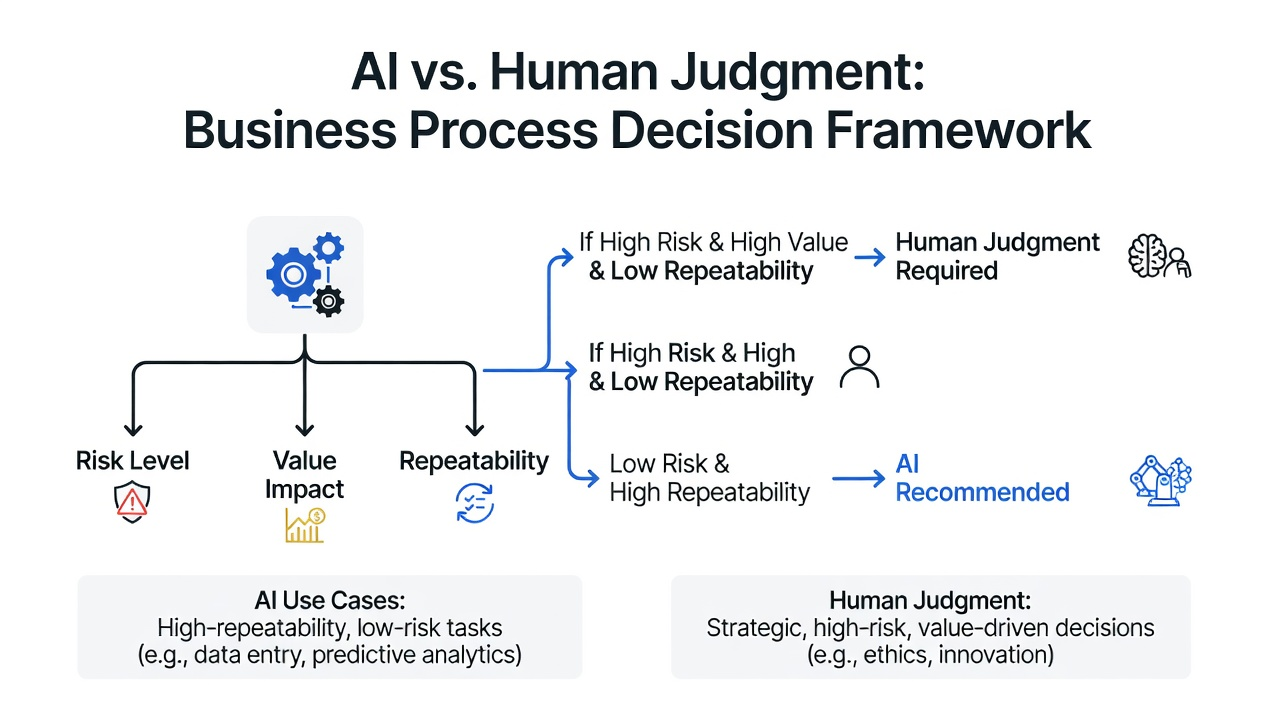
AI Process Selection Guide: 5 Filters to Decide When NOT to Automate Operations
Picture this: an operations team rushes to automate customer dispute resolution with AI, chasing efficiency gains. Weeks later, escalation rates skyrocket, trust erodes, and the fix costs triple the savings. Sound familiar? In the rush to deploy AI, too many leaders overlook the pitfalls, turning promising tools into operational headaches.
Smart AI process selection isn't about automating everything—it's about knowing when not to. This guide equips operations executives, managers, and process designers with five battle-tested filters for operations automation decisions. Rooted in a simple operating principle: automate the routine, augment the complex, and reserve humans for high-stakes judgment. Apply these to sharpen your operational judgment and avoid costly missteps.
The Guiding Principle: Automate Routine, Augment Complex, Humanize High-Stakes
Before diving into the filters, anchor your thinking in this triad. Routine tasks—like data entry or inventory checks—beg for full automation, freeing teams for value-add work. Complex processes, such as supply chain optimization, benefit from AI augmentation: algorithms suggest, humans decide. High-stakes areas demanding nuance, empathy, or ethical calls? Keep the human touch. This framework ensures AI amplifies, not undermines, your operations.
When in doubt, ask: Does this process thrive on rules, patterns, or people?
Filter 1: Repeatability—Is It Predictably Repetitive?
AI shines where tasks repeat like clockwork. High repeatability means clear rules and consistent inputs, minimizing errors. Low repeatability? Walk away.
Good Fit Example
Invoice matching: Scan, extract data, verify against records. 95% identical each cycle.
Poor Fit Example
Ad-hoc vendor negotiations: Every deal twists with unique terms, market shifts, relationships.
Key Question: Can you document the process in a flowchart with <10 decision points?
Filter 2: Risk—Can You Afford the Failure Mode?
Weigh the downside. When not to use AI? When errors cascade into regulatory fines, safety issues, or reputational damage. Low-risk processes tolerate AI's occasional hiccups; high-risk demand perfection humans might deliver.
- Good Fit: Email sorting—wrong folder? Minor annoyance.
- Poor Fit: Medical dosage calculations—millimeter errors kill.
Key Question: What's the worst-case cost of a 1% error rate?
Filter 3: Judgment—Does It Require Human Nuance?
AI excels at patterns, falters on context. Processes heavy on ethical calls, creativity, or empathy scream for operational judgment. Augment here, don't replace.
Good Fit Example
Predictive maintenance alerts—AI flags, mechanic verifies.
Poor Fit Example
Performance reviews—AI scores data, but motivation and growth need human insight.
Key Question: Would a robot handle this empathetically?
Filter 4: Data Quality—Is Fuel Reliable and Abundant?
Garbage in, garbage out. AI process selection hinges on clean, voluminous data. Sparse, noisy, or biased inputs doom automation.
- Good Fit: Demand forecasting with years of sales logs.
- Poor Fit: New-market pricing with patchy competitor intel.
Key Question: Do you have 6+ months of structured, accurate data at 90%+ quality?
Filter 5: Customer Impact—Will It Shape Perceptions?
Customers forgive backend bots but bristle at faceless frontline ones. High-visibility touchpoints need human warmth to build loyalty.
Good Fit Example
Order status updates—fast, factual.
Poor Fit Example
Complex refunds—empathy turns detractors into advocates.
Key Question: Does this interaction define the customer experience?
Your AI Process Selection Checklist
- Score repeatability: High? Proceed. Low? Pause.
- Assess risk: Acceptable failure cost? Green light.
- Evaluate judgment needs: Routine rules? Automate. Nuance? Augment/human.
- Check data: Quality/abundance? Yes.
- Gauge customer impact: Backend? Fine. Frontline? Human-first.
Tally your nos—if more than two, reconsider. This isn't anti-AI; it's pro-success.
Master Operations Automation Decisions
These filters transform guesswork into disciplined AI process selection. Deploy them to sidestep traps, maximize ROI, and elevate your operations. For a deeper dive, download our full checklist or book a strategy session.
In the end, the best automation leaves humans doing what machines can't: leading with wisdom. Choose thoughtfully—your operations will thank you.