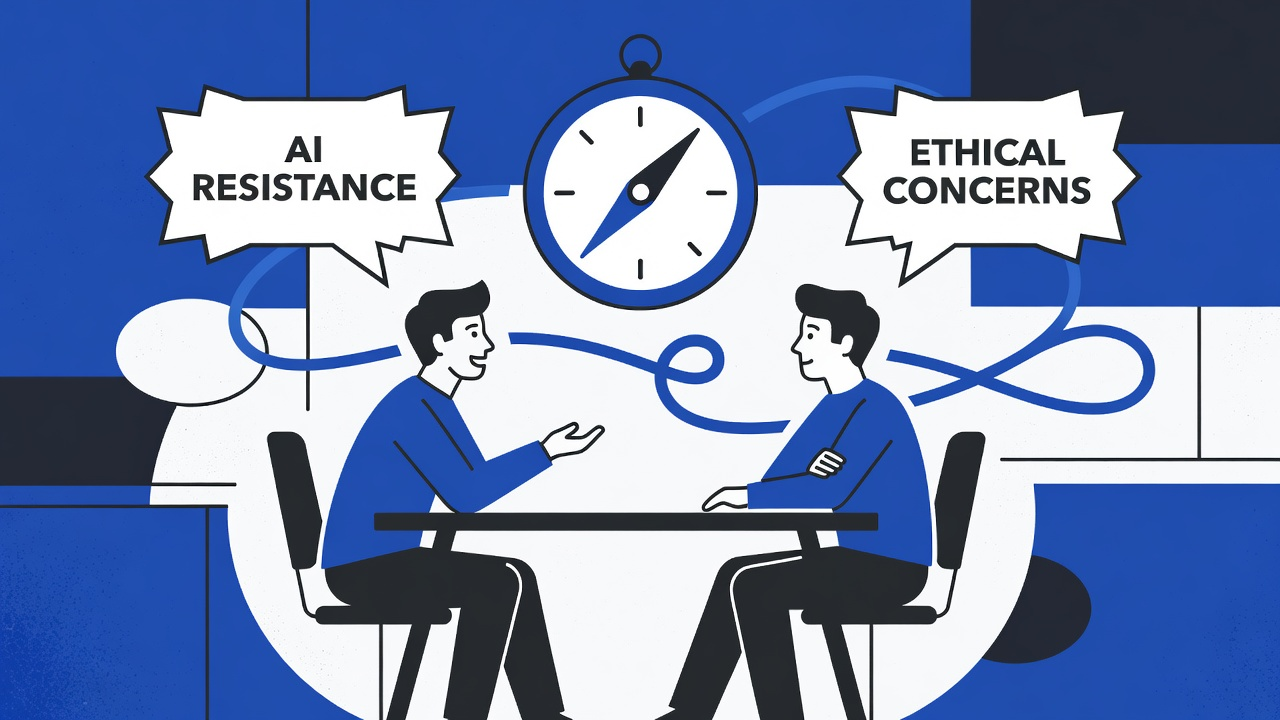
Overcoming AI Resistance: Practical Frameworks for Ethics, Uncertainty, and Adoption Success
Picture this: You're pitching the latest AI tool to your team, visions of streamlined workflows dancing in your head. Then, the questions erupt—"Will this replace my job?" "How do we know it's fair?" "What if it messes up our quality?" The room tenses. AI resistance isn't just pushback; it's a signal that your people need more than tech specs. They need trust, clarity, and a path forward.
As a leader, confronting AI resistance head-on can transform skepticism into momentum. This article equips you with practical frameworks for AI ethics operations, strategies for managing uncertainty in AI adoption, and tools to address core concerns like job security, fairness, quality, and autonomy. Let's break it down step by step, balancing innovation's promise with the human realities it disrupts.
The Roots of AI Resistance: Listening Before Leading
AI resistance often stems from four pillars of concern. Job security fears the automaton overtaking the artisan. Fairness worries about biased algorithms perpetuating inequality. Quality doubts whether machine outputs match human precision. Autonomy chafes at the loss of control, turning creators into button-pushers.
The first framework? A listening loop. Start meetings with open forums: "What worries you most about this AI?" Categorize feedback into those four buckets. This isn't lip service—it's data. One manager reframed a stalled project by mapping concerns to pilots, proving AI as augmenter, not replacer.
Build Your Concern Mapping Framework
- Collect: Anonymous surveys or roundtables.
- Classify: Tag inputs to job security, fairness, etc.
- Validate: Share aggregated insights: "40% cite fairness—here's our plan."
- Iterate: Revisit quarterly.
AI Ethics Operations: Your Operational Backbone
AI ethics operations turn vague principles into checklists. Embed ethics not as a side quest, but as the guardrails guiding every deployment. Think of it as the constitution for your AI republic—clear, enforceable, and evolving.
Ethical Review Questions Checklist
- Does the data reflect our workforce diversity?
- Can we audit decisions for bias?
- What human overrides exist for edge cases?
- How do we measure and report on fairness metrics?
- Is training mandatory for all users?
Implement via a cross-functional ethics board—rotate members from IT, HR, and frontline teams. Review every AI initiative against this before greenlighting. This operationalizes ethics, quelling fairness fears with transparency.
Managing Uncertainty in AI Adoption: From Fog to Focus
Managing uncertainty in AI adoption means piloting boldly but scaling cautiously. Uncertainty thrives in the unknown; counter it with staged rollouts. Begin with "AI sandboxes"—isolated tests where volunteers experiment risk-free.
Address quality by benchmarking: Run AI alongside humans, tracking error rates. For autonomy, design hybrid workflows—AI handles rote tasks, humans steer strategy. Job security? Retrain via "AI fluency programs," positioning staff as indispensable orchestrators.
Uncertainty isn't the enemy; unmanaged, it is. Frameworks turn it into fuel for informed choices.
Phased Adoption Roadmap
- Pilot (1-3 months): Small team, measure baselines.
- Expand (3-6 months): Incorporate feedback, refine ethics.
- Scale (6+ months): Full rollout with monitoring dashboards.
Response Scripts: Defuse Resistance with Precision
Words matter. Arm yourself with scripts tailored to concerns:
- Job Security: "AI frees you for high-value work. Here's our upskilling plan—100% coverage."
- Fairness: "We've audited data and built bias checks. Join our ethics review."
- Quality: "Pilots show 20% faster with equal accuracy—your oversight ensures it."
- Autonomy: "You decide when to use it. Training empowers your call."
Practice these. They rebuild trust brick by empathetic brick.
Chart the Path Forward
Overcoming AI resistance demands blending empathy with execution. These frameworks—listening loops, ethics ops, uncertainty management—don't just ease adoption; they elevate it. Your team isn't resisting change; they're resisting the unknown. Light the way.
Ready to operationalize? Download our free AI Ethics Operations Guide and sign up for the Managing Uncertainty Webinar. Lead the transformation—today.