#1 Amazon Bestseller in Organizational Behavior · JIM MARSH

    CULTURETAX

    How Misalignment Is Costing You Millions

    Your strategy isn't the problem. The hidden tax underneath it is the rework, the second-guessing, the meetings after the meeting. Culture Tax names that cost, shows you where it's leaking, and gives you a system to stop it in 90 days.

    NOW AVAILABLE ON AMAZONTHE CULTURE OS™ 90-DAY SYSTEMELEVATE YOUR LEADERSHIP
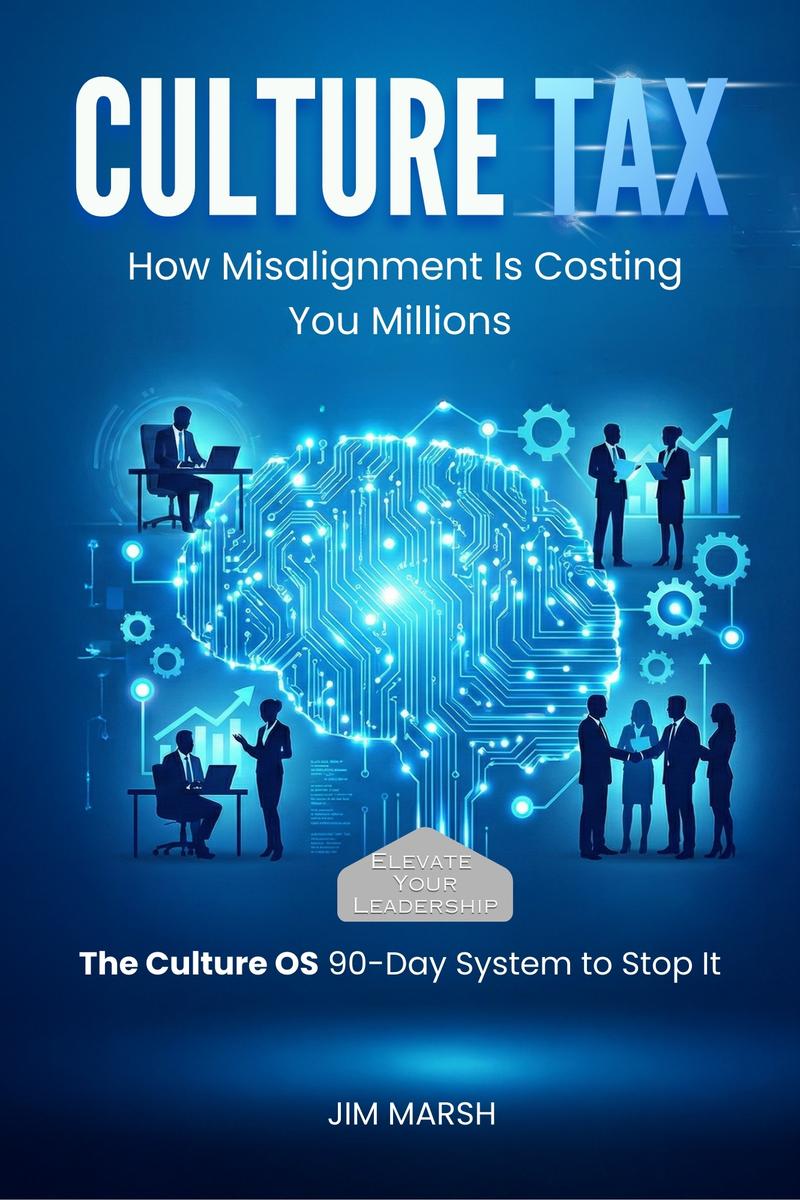
    Cover of Culture Tax: How Misalignment Is Costing You Millions by Jim Marsh
    ELEVATE YOUR
    LEADERSHIP

    CULTURE TAX · JIM MARSH

    • TurnoverGood people leaving
    • ReworkWork done twice
    • DecisionsSlow, second-guessed calls
    • CommunicationMessages that don't land
    • CoordinationTeams out of sync
    • InnovationIdeas that never ship

    You're already paying it.
    It's just not on the P&L.

    The Culture Tax is the invisible cost of misalignment, what you lose when values, priorities, and day-to-day behavior don't line up. It shows up in six places: turnover, rework, decisions, communication, coordination, and innovation. You won't find it in a budget line. You'll find it in everything that takes too long, costs too much, or has to be done again.

    01 · TURNOVER

    Good people leave

    When the culture people experience doesn't match the culture leaders describe, your best people walk and take their knowledge, relationships, and momentum with them. Replacement costs far more than retention ever would.

    02 · REWORK

    Work gets done twice

    Priorities shift, expectations stay unspoken, and teams fill the gaps with guesses. The work gets done, then gets redone because direction wasn't clear the first time.

    03 · DECISIONS

    Decisions stall and get revisited

    Without clear priorities and ownership, decisions take weeks when they should take a day, then get second-guessed, reopened, and relitigated in the meeting after the meeting.

    04 · COMMUNICATION

    Messages don't land

    What leaders mean isn't what teams hear. Updates get lost, context goes missing, and people work from different versions of the truth, so effort goes up while understanding goes down.

    05 · COORDINATION

    Teams fall out of sync

    Departments hit their own targets while the company misses its. Handoffs fail, work gets duplicated, and busy teams pull in different directions instead of moving together.

    06 · INNOVATION

    New ideas never take off

    When people are busy protecting themselves, fixing friction, or redoing work, there's no energy left to experiment. Ideas stall, risks feel unsafe, and the future gets postponed.

    Estimate your Culture Tax

    Move the sliders to your best guess. This is an illustrative estimate based on your inputs. The book shows you how to find the real number inside your own organization.

    What misalignment costs you

    Three inputs. One uncomfortable number.

    75 people
    $95,000
    15%

    Estimated annual Culture Tax

    $1,068,750

    That's about $14,250 per person, per year spent on friction instead of forward motion.

    Illustrative only: team size × average cost × time lost. Your actual tax includes turnover, delays, and missed opportunities on top of this.

    Email me my result

    Get your number, the breakdown, and the first step of the Culture OS 90-Day System.

    No spam. Your details stay private — see our Privacy Policy

    The Culture OS™ 90-Day System

    An operating system installed in three 30-day phases, so alignment becomes how the company runs.

    See It: Diagnose the Tax

    You can't fix a cost you can't see. The first 30 days make misalignment visible and measurable.

    • Audit where time, trust, and momentum are leaking
    • Name the specific behaviors behind the rework and drag
    • Get the leadership team looking at the same picture together

    What you'll walk away with

    A clear diagnosis, a common language for your leadership team, and a practical system you can start on Monday.

    01

    Name the tax

    How to spot misalignment's hidden costs and make them visible to the whole leadership team.

    02

    Find the leaks

    Where culture actually breaks down: in decisions, handoffs, meetings, and unspoken expectations.

    03

    Align the team

    How to get leaders pulling in the same direction, with the same priorities, in the same language.

    04

    Install Culture OS™

    The rhythms, behaviors, and accountability that keep alignment in place after the kickoff energy fades.

    Who this is for

    • Founders & CEOs who feel the drag but can't name it
    • COOs and operators tired of rework and slow decisions
    • People & culture leaders who need more than a survey
    • Any leadership team that's busy but not aligned

    Who this is not for

    • Leaders looking for a slogan instead of a system
    • Teams unwilling to look honestly at how they work
    • Anyone who thinks culture is HR's problem alone

    Table of contents

    • The Boardroomp. 6
    • The $22 Million Problem No One's Talking Aboutp. 7
    • Where Are You Now?p. 19
    • The Culture Dividend Promisep. 21
    • Four Implementation Pathwaysp. 23

    Part ILeadership Foundations of High Performancep. 31

    • Chapter 1 — Defining Your Organization’s Cultural Visionp. 33
    • Chapter 2 — From Vicious Cycle (Tax) to Virtuous Circle (Dividend)p. 41
    • Chapter 3 — Assessing Your Current Culturep. 50
    • Chapter 4 — Defining High Performancep. 60
    • Chapter 5 — The Culture Tax ↔ Dividend Frameworkp. 71

    Part IIEmbedding Culture into Daily Workp. 87

    • Chapter 6 — Communicating the Culture Effectivelyp. 89
    • Chapter 7 — Designing Teams for Cultural Fit and High Performancep. 116
    • Chapter 8 — Integrating Culture into Core Processesp. 127

    Part IIIAlignment, Accountability & Reinforcementp. 136

    • Chapter 9 — Setting Goals and Measuring Resultsp. 137
    • Chapter 10 — Reinforcing Good Behavior Through Incentivesp. 147
    • Chapter 11 — Correcting Bad Behavior Swiftlyp. 158

    Part IVScaling & Sustaining the Culture OSp. 172

    • Chapter 12 — The Daily Reinforcement Enginep. 173
    • Chapter 13 — Feedback, Correction & Escalationp. 177
    • Chapter 14 — Overcoming Common Obstacles to Cultural Changep. 195
    • Chapter 15 — Updating and Sustaining Cultural Practicesp. 208
    • Chapter 16 — Leading Culture in Remote & Global Teamsp. 218
    • Chapter 17 — Your Readiness for Agile Executionp. 226
    Jim Marsh, author of Culture Tax

    Jim Marsh

    Jim Marsh is the author of Culture Tax: How Misalignment Is Costing You Millions. His work centers on a simple conviction: culture is an operating system, and when it's misaligned, the whole company pays for it every day.

    In Culture Tax, he lays out the Culture OS™ 90-Day System, a practical path for leaders who want to elevate their leadership, stop the hidden tax, and build a team that moves in the same direction.

    Jim is the founder of JEM Premier Coaching and brings more than 30 years of operations experience to his work with leaders and teams.

    Explore more resources

    Before you ask

    What exactly is the “Culture Tax”?

    It's the hidden cost of misalignment, paid across six components: turnover, rework, decisions, communication, coordination, and innovation.

    What is Culture OS™?

    Culture OS™ is the 90-day system at the heart of the book: a structured way to diagnose the tax, align your leadership team, and install the rhythms and behaviors that keep the company aligned.

    Do I need to be a CEO to use this?

    No. It's written for anyone who leads people and feels the cost of misalignment, including founders, executives, operators, and people leaders. The system works best when the leadership team does it together.

    Where can I buy the book?

    Culture Tax is available now on Amazon.

    Stop paying the tax.

    Culture Tax: How Misalignment Is Costing You Millions is available now on Amazon. Get the book, see the six components of the tax in your own organization, and start the Culture OS™ 90-Day System to stop it.

    See the six components